

Successful Communication Styles Starts with Knowing Your Personality Style
Bradford R. GlaserWhat is communication style? When asked, many people think of two or more people engaged in conversation. But communication is a multifaceted series of actions and interpretations, simultaneously more complex and simpler than conversation. There are four forms of communication: verbal, paraverbal, body language, and personal space. All four forms send messages to other people.
Personality style is an important part of all forms of communication. If people are aware of another person’s typical behaviors, they will take them into account when interpreting that person's actions.
For example, if your coworker Fred is generally a friendly and outgoing person, his enthusiastic hello should not be interpreted as a sign of deep friendship. On the other hand, if Fred is a private person and gives you an enthusiastic hello, that might be taken as a sign of friendship. Knowledge of style sets up expectations of certain behaviors, so when the unexpected occurs, people can more accurately attach meaning to it.
In this post, we’ll get into the four different forms and styles of communication so you can see how they interact and shape the way we interpret and deliver information, ultimately leading to greater awareness and even better communication. Let’s get into it!
- Discover your unique style
- Capitalize on your style strengths
- Flex your communication style
Table of Contents
The Four Types of Communication
- Verbal Communication: Although we choose the words we say, our intended meaning may not be shared by those who hear them. Because of differences in age, experience, and background, words have different meanings to different people.
- Paraverbal Communication: It’s not only the words we say but the way we say them that communicates meaning. How quickly one speaks, pauses, and the tone and intensity of one's voice all convey a message.
- Body Language: The way we stand, maintain eye contact, and even shake hands all communicate meaning to others. Body language is also heavily influenced by style. Our preferences for eye contact, gesturing, and touch are usually quite pronounced. It’s much easier to read another person’s body language message if you know his or her style.
- Communication and Personal Space: Personal space is not only the space between you and others, but also how you arrange your desk or workspace, your personal appearance, and your choice of decorations. Interpersonal distance is also an element of personal space. How close we prefer to be to others is another aspect of our styles that can significantly affect how our communication is interpreted.
The Four Communication Styles
Because our communication style affects our interactions with others, a better understanding of our own style can lead to more effective communication. HRDQ’s research and style model, founded upon the works of William Moulton Marston, Carl Jung, and others, has revealed two basic dimensions of style: Expressiveness and Assertiveness. Assertiveness is the effort a person makes to influence or control others' thoughts or actions. Expressiveness is the effort that a person makes to control his or her emotions and feelings when relating to others.
There are varying levels and combinations of Assertiveness and Expressiveness that form the basis of four personality styles: Direct, Spirited, Considerate, and Systematic.
How Personality Style Shapes Communication
Knowing the four forms of communication is useful, but understanding how personality style influences each one is what allows us to truly connect with others. Each of the four styles: Direct, Spirited, Systematic, and Considerate – has distinct tendencies across verbal, paraverbal, body language, and personal space communication.
Direct communicators tend to be straightforward and economical with words, speaking in declarative sentences and getting to the point quickly. Their tone is confident and steady, with few pauses or hedging. They maintain strong eye contact and use firm handshakes, and their workspaces are often minimal and functional – organized around efficiency rather than personal expression.
Spirited communicators are expressive and animated, using vivid language and storytelling to make their point. Their voice varies in tone and pace, rising with enthusiasm when engaged. They gesture freely, make broad eye contact with a room, and their personal spaces often reflect their personality – colorful, eclectic, and conversation-starting.
Considerate communicators lean toward warm, inclusive language, asking questions and inviting others to share. Their tone is gentle and unhurried, with a natural ability to listen as much as they speak. Their body language is open and welcoming, and their spaces are often personalized with photos or mementos that signal approachability.
Systematic communicators choose their words carefully, favoring precise language and logical structure. They speak at a measured pace, pausing to think before responding. Their body language tends to be reserved, with controlled gestures and moderate eye contact. Their personal spaces often reflect their attention to detail – organized, labeled, and purposeful.
Recognizing these tendencies in yourself and others doesn't mean putting people in boxes – it means having a richer vocabulary for interpreting behavior. A Spirited colleague who dominates a meeting isn't being rude; they're engaged. A Systematic manager who responds to your idea with silence isn't dismissing it; they're processing. Style awareness turns potential friction into understanding.
Understanding our own personality style and others' can make effective communication much easier. Making adjustments to our own behavior to accommodate another person’s style can make that person feel more at ease with us and help us achieve our goals more readily.
Discover Your Style with HRDQ
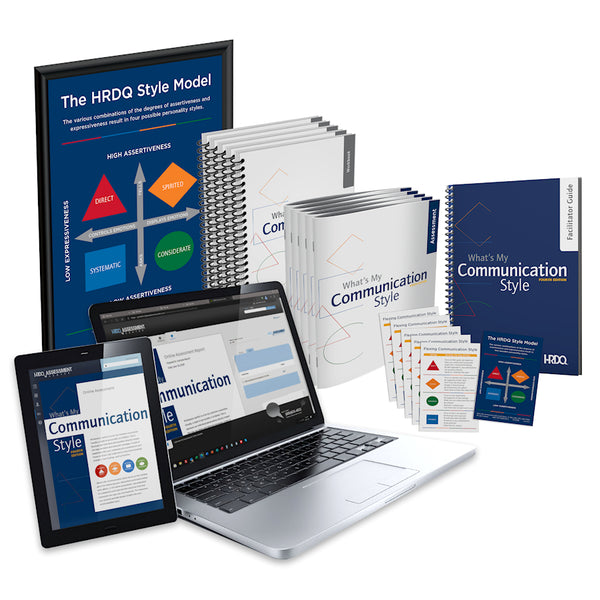
HRDQ's What's My Communication Style assessment is a quick, 10-minute assessment that identifies your levels of Assertiveness and Expressiveness to create a unique communication style profile across the four styles: Direct, Spirited, Considerate, and Systematic. Participants will discover their style and their unique traits, learn how to capitalize on their strengths while limiting their trouble spots, and how to flex their style to effectively communicate with anyone.
Get started today – take the assessment and discover your style!