

What Are the Benefits of Using the Thomas-Kilmann Model?
Bradford R. GlaserWorkplace disagreements are just plain exhausting, and they have this way of derailing your entire team's productivity faster than just about any other issue that comes up. Small tensions between coworkers start to accumulate, then those tough conversations get pushed off for weeks (sometimes even months), and eventually you're left with missed deadlines, damaged relationships and talented employees who are quietly scanning job boards on their lunch breaks. Most of us were never taught how to work through conflict in a healthy, productive way – schools sure don't cover it, and many workplaces just hope their teams will somehow figure it out on their own!
The Thomas-Kilmann Model is a framework that was built on research, and it's been around for more than 40 years, helping businesses and teams to work through conflict in a practical way. Kenneth Thomas and Ralph Kilmann put together their assessment tool, and since then, more than 10 million copies have made their way into offices and workplaces all over the world. When something sticks around for that long and gets used by that many organizations, there's usually something real behind it. In this case, what's real is that most of us fall into pretty predictable patterns when we face disagreements or conflict. When you pick up on these patterns (in yourself and in the others around you), it gets much easier to see what's actually going on and how to work through it in a way that actually works.
It really changes your day-to-day work life and how your entire team works together. The model splits conflict reactions into five different styles, and each style relies on a different blend of assertiveness and cooperation. None of these styles is inherently right or wrong – it just depends on picking the right response for whatever situation is happening at that time. Teams that perform well can flex between styles as needed, whereas teams that struggle will fall into the same unproductive conflicts again and again. This type of flexibility strengthens collaboration, speeds up decisions and increases job satisfaction across the board.
Let's look at how the Thomas-Kilmann Model can change the way you approach conflict!
- Discover 5 ways to respond to conflict
- Explore the integrating conflict strategy
- Improve conflict responses
Table of Contents
The Five Ways to Handle Conflict
The Thomas-Kilmann model breaks conflict management down into five different styles. Kenneth Thomas and Ralph Kilmann developed this model back in the 1970s after years of research into what happens when people's needs clash. Their work revealed that no matter who they studied or what the situation was, the same basic patterns kept coming up again and again in how people handle disagreements.
The five conflict styles all come from the same framework, and it's built on just two core dimensions. The first dimension is assertiveness and measures how much you're willing to stand up for what you need and your interests when there's a disagreement. The second dimension is cooperativeness, and it measures how willing you are to help the other person achieve what they need from the situation. Each of the five conflict styles represents a different combination of these two dimensions. Some styles rate high in one dimension and low in the other, and others fall somewhere in the middle, and that's how we get the five styles.

The competing style is all about assertiveness with zero concern for cooperation. Accommodation flips this – you put what the other person wants above what you need. With avoidance, you step back from assertiveness and cooperation altogether. Collaboration rates high on both, with everyone actively working to find an answer where everybody gets what they need. Compromise falls right in the middle of the others, with each side willing to give something up to reach an agreement.
This model helps you see patterns in how you actually behave. Maybe you cave every time your boss pushes back on something. With coworkers, though, you might be a lot more aggressive. Or maybe collaboration comes with family at home. But at work, you'd prefer to stay quiet and avoid any confrontation.
When you learn your own style, it helps with something else, too – it makes it much easier to read those around you. When you can read someone's usual communication style, their reactions start to make a lot more sense. It's easier to predict how they'll respond. This awareness can change how you approach tough conversations. Instead of feeling frustrated when a person reacts poorly, or assuming that it's personal, you'll just see it as their normal pattern – probably the exact response you were expecting from them anyway.
All five of these styles have their place, and none of them is going to outperform the others in every scenario. Each style works in some situations but doesn't work in others. The right choice depends on the specific situation.
Discover How You Really Handle Conflict
The assessment does something that usually goes unnoticed at first. It shows you which conflict style you automatically lean toward when you're not actively making a choice about how to respond. Most of us have one style (maybe two at most) that feels more natural and easier for us to default to. We go back to those same strategies repeatedly, mainly because they've worked well enough for us before.
Studies have found that roughly 68% of us lean way too heavily on our preferred conflict style, even when a different strategy would work much better for the situation we're in. A person might always push for collaboration, even in moments where a competitive stance is what's actually needed. Others accommodate to the degree that their own needs and priorities get pushed off to the side.
The assessment includes 30 questions about how you normally handle different types of conflict situations. Each question measures how much you rely on each of the five conflict styles. After you finish it and receive your results, you'll have a much better sense of your natural patterns and default tendencies. More than that, you'll be able to see exactly where you could be stuck in habits that just aren't working for you anymore.

What makes this assessment so helpful is the relief it tends to bring. The way you automatically respond when conflict shows up doesn't mean you're flawed or that something's wrong with you. These are just habits that you learned at some point in your life. And because you learned them, you can also change them. With enough practice, you can build new ways to respond and have many more options available to you whenever you need them.
It is much easier to make better decisions when it counts. You might discover that you've been defaulting to compromise in situations where accommodation would have actually worked out better for everyone involved. At the same time, competition gets a bad rap. But sometimes that's the best strategy to take, even when your instinct tells you to stay away from it.
Build Your Emotional Intelligence with Self-Awareness
Emotional intelligence tends to develop after you get familiar with your default conflict style – it's almost like it builds itself up from there. Daniel Goleman defines emotional intelligence as the ability to sense and manage your own emotions and to read what those around you are feeling. The Thomas-Kilmann model is a great tool for this because it helps you recognize your own behavioral patterns as they're happening.
You start to see a pattern where you always accommodate others, even in situations where you should really be speaking up for yourself. Or maybe you notice that you go straight into compete mode every time anyone challenges one of your ideas. Recognizing yourself in those moments gives you a chance to pause and think about how you want to take care of the situation instead of running on autopilot.
The research on this actually looks pretty strong. Multiple studies have found that managers who score higher on the emotional intelligence assessments usually lead teams that perform about 20% better on average. A performance gap like that one matters because your own self-awareness can have a direct, measurable effect on those around you every day.

The benefit here is in that little bit of space it creates, the difference between what goes on around you and how you actually respond to it. If you don't have that gap, most of us will just respond based on old habits or whatever emotion hits us right then. With it, you can pick a response that fits what's needed in front of you. Maybe in one situation, it makes more sense to work together with another person instead of competing. Another situation might finally be the time to stand firm instead of trying to accommodate everyone else like you always do.
This type of awareness won't magically solve every conflict that comes your way. What it will do is let you make better calls when a situation starts to heat up. And when you can do that (pause and choose how to respond instead of acting on impulse), it usually works out better for everyone.
Match Your Style to the Right Situation
The Thomas-Kilmann model explains when each conflict style makes sense to use and when you're actually better off staying away from them completely. Every situation that comes up at work is a little different, and what works for one problem might backfire if you try it on another.
Different conflict situations call for different management approaches, and managers who understand this principle usually do much better than managers who don't. Studies on workplace situations show that managers who adjust their conflict style based on the situation at hand score roughly 30% higher on effectiveness ratings than managers who stick with the same strategy every time. Flexibility makes a genuine difference in how well you can take care of the conflicts and challenges that come up in any workplace.

Competition can work as a leadership style if you have an emergency situation and the decisions need to be made fast. If a safety issue pops up or a deadline can't be moved, time isn't on your side. You can't get input from the entire team when every second counts. Somebody has to make the call fast and keep everything moving forward.
Collaboration tends to work much better if you have complex problems that need buy-in from multiple teams across different areas. A workflow redesign that touches three different departments makes sense to get input from everyone who will be impacted, so they can each share their view of how things currently work and what actually needs to change. The answer you get is going to be much stronger as a result of all that combined input, and just as important, team members are a lot more likely to support the changes when they've been part of the process from the start.
Flexibility isn't the same as being unpredictable, though. What it means is that you're able to read the situation and adjust how you approach it based on what's needed at that time. The biggest mistake happens when a manager finds one conflict style that works for them, and then they use it for everything. A manager who competes all the time is going to damage relationships over small issues that don't need to turn into battles. When a manager accommodates every request that comes their way, their team's needs probably won't ever get the support that those needs deserve. What this model does is give you a simple way to size up each conflict situation, to work out what that situation calls for and then adjust your response to match it.
How Your Team Can Handle Conflicts
Conflict styles are worth talking about as a team because the whole group usually benefits from that openness. Once everyone starts to share how they handle disagreements, you'll start to see patterns in how your colleagues respond when the pressure is on. If a team member goes quiet during a heated conversation, it doesn't automatically mean they're passive or uninterested in the topic at hand. A lot of the time, they just need to take a step back and work through everything in their heads first before they're ready to speak up and contribute.
Studies are showing this, too – teams that talk about their conflict profiles together wind up with 40% less unresolved conflicts than teams who don't have this conversation and never actually get into how everyone prefers to handle disagreements. After everyone on a team gets familiar with how their coworkers think, the workplace relationships usually make a lot more sense.
A colleague who pushes back hard on your idea probably isn't out to undermine you or to attack you personally – competition just happens to be their default setting when conflict comes into play. When you know this about them, it's much easier to read their reactions accurately and to respond appropriately.

A lot of teams will actually change the way that they run their meetings once everyone has a better sense of one another's conflict style. A manager might add some extra time into the group discussions so the team members who like to process everything have enough space to think it through before they have to respond. Other teams will take a second look at how they're assigning projects and try to get a better mix of different conflict strategies represented on each one. A collaborator and a competitor on the same project together can work out really well when each of them knows what the other person is best at and how they add to the team.
Improvements like this don't need some massive overhaul of your entire team culture. Just a few small changes to how your entire team communicates can make day-to-day work go much smoother. The important piece is probably awareness – when conflict does pop up, it really helps if everyone on the team understands at least a little bit about where their coworkers are coming from.
Put These Ideas to The Test
Workplace tension tends to build up if you don't have a picture of your own patterns, or if you can't quite put your finger on what actually triggers that reaction from the other person.
Conflict styles are interesting to read about. But the practice is what makes all this information actually matter in life. It's easy enough to learn about different conflict styles and nod along as you go through the material. Your own preferences and how to adapt to different situations – well, that takes time, some honest reflection and usually at least a little help from someone else. Teams that handle conflict well are usually the ones that create space for open conversations and give everyone the right tools to better read themselves and one another. Once everyone on the team feels confident they can work through tough situations without doubt, the office culture gets better in ways that help everyone.

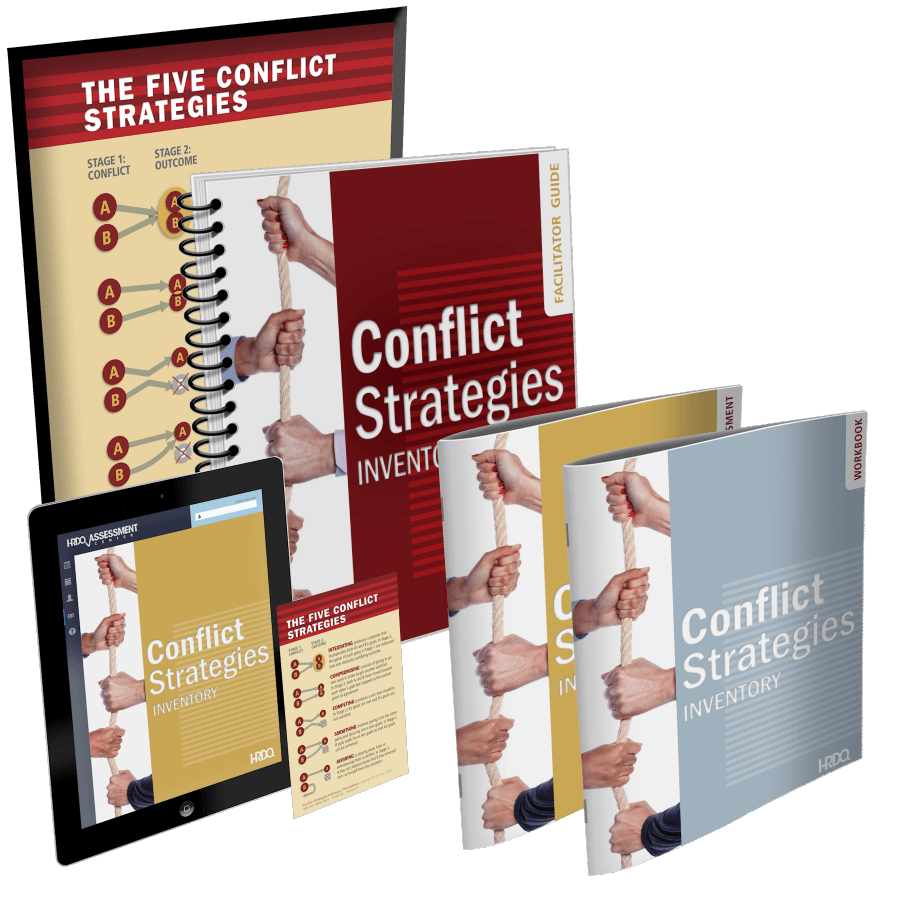
For an easy way to introduce these concepts across your entire team, our Conflict Strategies Inventory at HRDQ is a solid place to start. We walk you and your colleagues through an assessment that helps everyone identify their own conflict management style and then gives you concrete ways that you can use to work through disputes better. The whole point is to cut down on workplace tension and to create a culture where you talk through problems when they pop up as part of how the workplace operates – not something that makes everyone uncomfortable.